


Page 57 - Demo
P. 57
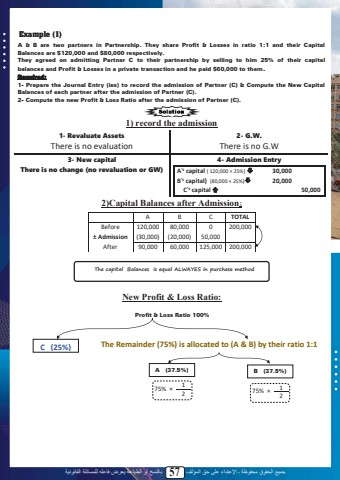
%u062c%u0645%u064a%u0639 %u0627%u0644%u062d%u0642%u0648%u0642 %u0645%u062d%u0641%u0648%u0638%u0629 %u0640 %u0627%u0625%u0644%u0639%u062a%u062f%u0627%u0621 %u0639%u0644%u0649 %u062d%u0642 %u0627%u0644%u0645%u0624%u0644%u0641 57 %u0628%u0627%u0644%u0646%u0633%u062e %u0623%u0648 %u0627%u0644%u0637%u0628%u0627%u0639%u0629 %u064a%u0639%u0631%u0636 %u0641%u0627%u0639%u0644%u0647 %u0644%u0644%u0645%u0633%u0627%u0626%u0644%u0629 %u0627%u0644%u0642%u0627%u0646%u0648%u0646%u064a%u0629Example (1)A & B are two partners in Partnership. They share Profit & Losses in ratio 1:1 and their Capital Balances are $120,000 and $80,000 respectively. They agreed on admitting Partner C to their partnership by selling to him 25% of their capital balances and Profit & Losses in a private transaction and he paid $60,000 to them.Required: 1- Prepare the Journal Entry (ies) to record the admission of Partner (C) & Compute the New Capital Balances of each partner after the admission of Partner (C).2- Compute the new Profit & Loss Ratio after the admission of Partner (C).1) record the admission1- Revaluate AssetsThere is no evaluation2- G.W.There is no G.W3- New capitalThere is no change (no revaluation or GW)4- Admission Entry A%u2019s capital ( 120,000 %u00d7 25%) %uf0c8 30,000B%u2019s capital) (80,000 %u00d7 25%)%uf0c8 20,000C%u2019s capital %uf0c7 50,0002)Capital Balances after Admission:A B C TOTALBefore 120,000 80,000 0 200,000%u00b1 Admission (30,000) (20,000) 50,000After 90,000 60,000 125,000 200,000New Profit & Loss Ratio: vz55Profit & Loss Ratio 100%C (25%) The Remainder (75%) is allocated to (A & B) by their ratio 1:1A (37.5%) B (37.5%)The capital Balances is equal ALWAYES in purchase method75% %u00d7 12 75% %u00d7 12


