


Page 81 - Demo
P. 81
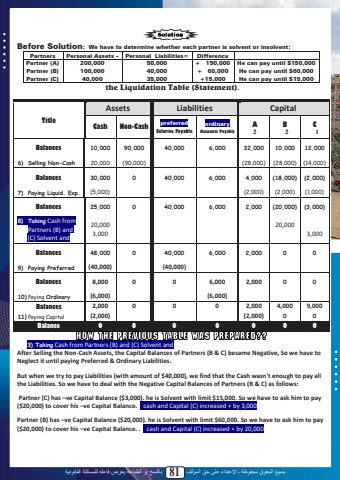
%u062c%u0645%u064a%u0639 %u0627%u0644%u062d%u0642%u0648%u0642 %u0645%u062d%u0641%u0648%u0638%u0629 %u0640 %u0627%u0625%u0644%u0639%u062a%u062f%u0627%u0621 %u0639%u0644%u0649 %u062d%u0642 %u0627%u0644%u0645%u0624%u0644%u0641 81 %u0628%u0627%u0644%u0646%u0633%u062e %u0623%u0648 %u0627%u0644%u0637%u0628%u0627%u0639%u0629 %u064a%u0639%u0631%u0636 %u0641%u0627%u0639%u0644%u0647 %u0644%u0644%u0645%u0633%u0627%u0626%u0644%u0629 %u0627%u0644%u0642%u0627%u0646%u0648%u0646%u064a%u0629Before Solution: We have to determine whether each partner is solvent or insolvent:Partners Personal Assets - Personal Liabilities= DifferencePartner (A) 200,000 50,000 + 150,000 He can pay until $150,000Partner (B) 100,000 40,000 + 60,000 He can pay until $60,000Partner (C) 40,000 35,000 +15,000 He can pay until $15,000the Liquidation Table (Statement).TitleAssets Liabilities CapitalCash Non-Cash preferredSalaries PayableordinaryAccounts PayableA 2B 2C 1Balances 10,000 90,000 40,000 6,000 32,000 10,000 12,0006) Selling Non-Cash 20,000 (90,000) (28,000) (28,000) (14,000)Balances 30,000 0 40,000 6,000 4,000 (18,000) (2,000)7) Paying Liquid. Exp. (5,000) (2,000) (2,000) (1,000)Balances 25,000 0 40,000 6,000 2,000 (20,000) (3,000)8) Taking Cash from Partners (B) and (C) Solvent and20,0003,00020,0003,000Balances 48,000 0 40,000 6,000 2,000 0 09) Paying Preferred (40,000) (40,000)Balances 8,000 0 0 6,000 2,000 0 010) Paying Ordinary (6,000) (6,000)Balances 2,000 0 0 0 2,000 4,000 9,00011) Paying Capital (2,000) (2,000) 0 0Balance 0 0 0 0 0 0 03) Taking Cash from Partners (B) and (C) Solvent andAfter Selling the Non-Cash Assets, the Capital Balances of Partners (B & C) became Negative, So we have to Neglect it until paying Preferred & Ordinary Liabilities.But when we try to pay Liabilities (with amount of $40,000), we find that the Cash wasn't enough to pay all the Liabilities. So we have to deal with the Negative Capital Balances of Partners (B & C) as follows:Partner (C) has %u2013ve Capital Balance ($3,000). he is Solvent with limit $15,000. So we have to ask him to pay ($20,000) to cover his %u2013ve Capital Balance. cash and Capital (C) increased + by 3,000Partner (B) has %u2013ve Capital Balance ($20,000). he is Solvent with limit $60,000. So we have to ask him to pay ($20,000) to cover his %u2013ve Capital Balance. . cash and Capital (C) increased + by 20,000 79


