


Page 48 - Demo
P. 48
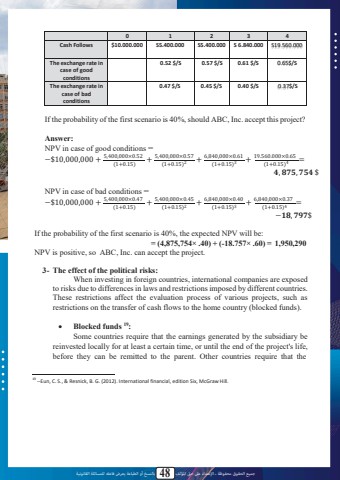
%u062c%u0645%u064a%u0639 %u0627%u0644%u062d%u0642%u0648%u0642 %u0645%u062d%u0641%u0648%u0638%u0629 %u0640 %u0627%u0625%u0644%u0639%u062a%u062f%u0627%u0621 %u0639%u0649%u0644 %u062d%u0642 %u0627%u0645%u0644%u0624%u0644%u0641 48 %u0628%u0627%u0644%u0646%u0633%u062e %u0623%u0648 %u0627%u0644%u0637%u0628%u0627%u0639%u0629 %u064a%u0639%u0631%u0636 %u0641%u0627%u0639%u0644%u0647 %u0644%u0644%u0645%u0633%u0627%u0626%u0644%u0629 %u0627%u0644%u0642%u0627%u0646%u0648%u0646%u064a%u06290 1 2 3 4Cash Follows $10.000.000 S5.400.000 S5.400.000 S 6.840.000 S19.560.000The exchange rate in case of goodconditions0.52 $/S 0.57 $/S 0.61 $/S 0.65$/SThe exchange rate in case of badconditions0.47 $/S 0.45 $/S 0.40 $/S 0.37$/SIf the probability of the first scenario is 40%, should ABC, Inc. accept this project?Answer:NPV in case of good conditions =%u2212$10,000,000 + 5,400,000%u00d70.52 + 5,400,000%u00d70.57 + 6,840,000%u00d70.61 + 19.560.000%u00d70.65 = (1+0.15)NPV in case of bad conditions =(1+0.15)2 (1+0.15)3 (1+0.15)4%ud835%udfd2%ud835%udfd2, %ud835%udfd6%ud835%udfd6%ud835%udfd5%ud835%udfd5%ud835%udfd3%ud835%udfd3,%ud835%udfd5%ud835%udfd5%ud835%udfd3%ud835%udfd3%ud835%udfd2%ud835%udfd2 $%u2212$10,000,000 + 5,400,000%u00d70.47 + 5,400,000%u00d70.45 + 6,840,000%u00d70.40 + 6,840,000%u00d70.37 = (1+0.15) (1+0.15)2 (1+0.15)3 (1+0.15)4%u2212%ud835%udfcf%ud835%udfcf%ud835%udfd6%ud835%udfd6, %ud835%udfd5%ud835%udfd5%ud835%udfd7%ud835%udfd7%ud835%udfd5%ud835%udfd5$If the probability of the first scenario is 40%, the expected NPV will be:= (4,875,754%u00d7 .40) + (-18.757%u00d7 .60) = 1,950,290NPV is positive, so ABC, Inc. can accept the project.3- The effect of the political risks:When investing in foreign countries, international companies are exposed to risks due to differences in laws and restrictionsimposed by different countries. These restrictions affect the evaluation process of various projects, such as restrictions on the transfer of cash flows to the home country (blocked funds).%uf0b7 Blocked funds 19:Some countries require that the earnings generated by the subsidiary be reinvested locally for at least a certain time, or until the end of the project's life, before they can be remitted to the parent. Other countries require that the19 --Eun, C. S., & Resnick, B. G. (2012). International financial, edition Six, McGraw Hill.


