


Page 11 - Demo
P. 11
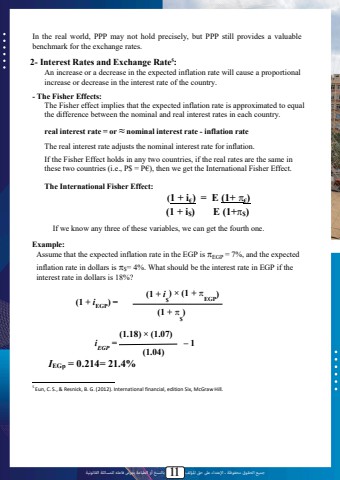
%u062c%u0645%u064a%u0639 %u0627%u0644%u062d%u0642%u0648%u0642 %u0645%u062d%u0641%u0648%u0638%u0629 %u0640 %u0627%u0625%u0644%u0639%u062a%u062f%u0627%u0621 %u0639%u0649%u0644 %u062d%u0642 %u0627%u0645%u0644%u0624%u0644%u0641 11 %u0628%u0627%u0644%u0646%u0633%u062e %u0623%u0648 %u0627%u0644%u0637%u0628%u0627%u0639%u0629 %u064a%u0639%u0631%u0636 %u0641%u0627%u0639%u0644%u0647 %u0644%u0644%u0645%u0633%u0627%u0626%u0644%u0629 %u0627%u0644%u0642%u0627%u0646%u0648%u0646%u064a%u0629In the real world, PPP may not hold precisely, but PPP still provides a valuable benchmark for the exchange rates.2- Interest Rates and Exchange Rate5:An increase or a decrease in the expected inflation rate will cause a proportional increase or decrease in the interest rate of the country.- The Fisher Effects:The Fisher effect implies that the expected inflation rate is approximated to equal the difference between the nominal and real interest rates in each country.real interest rate = or %u2248 nominal interest rate - inflation rateThe real interest rate adjusts the nominal interest rate for inflation.If the Fisher Effect holds in any two countries, if the real rates are the same in these two countries (i.e., P$ = P%u20ac), then we get the International Fisher Effect.The International Fisher Effect:(1 + i%u20ac) = E (1+ %uf070%u20ac)(1 + i$) E (1+%uf070$)If we know any three of these variables, we can get the fourth one.Example:Assume that the expected inflation rate in the EGP is %uf070EGP = 7%, and the expected inflation rate in dollars is %uf070$= 4%. What should be the interest rate in EGP if the interest rate in dollars is 18%?(1 + iEGP) = (1 + i ) %u00d7 (1 + %uf070$ EGP)iEGP =(1 + %uf070 )$(1.18) %u00d7 (1.07)%u2013 1(1.04)IEGp = 0.214= 21.4%5 Eun, C. S., & Resnick, B. G. (2012). International financial, edition Six, McGraw Hill.


