


Page 53 - Demo
P. 53
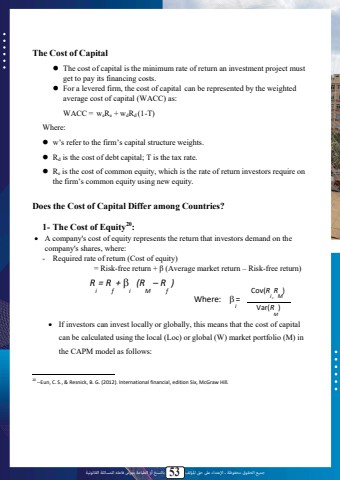
%u062c%u0645%u064a%u0639 %u0627%u0644%u062d%u0642%u0648%u0642 %u0645%u062d%u0641%u0648%u0638%u0629 %u0640 %u0627%u0625%u0644%u0639%u062a%u062f%u0627%u0621 %u0639%u0649%u0644 %u062d%u0642 %u0627%u0645%u0644%u0624%u0644%u0641 53 %u0628%u0627%u0644%u0646%u0633%u062e %u0623%u0648 %u0627%u0644%u0637%u0628%u0627%u0639%u0629 %u064a%u0639%u0631%u0636 %u0641%u0627%u0639%u0644%u0647 %u0644%u0644%u0645%u0633%u0627%u0626%u0644%u0629 %u0627%u0644%u0642%u0627%u0646%u0648%u0646%u064a%u0629The Cost of Capital%uf06c The cost of capital is the minimum rate of return an investment project must get to pay its financing costs.%uf06c For a levered firm, the cost of capital can be represented by the weighted average cost of capital (WACC) as:WACC = weRe + wdRd (1-T) Where:%uf06c w%u2019s refer to the firm%u2019s capital structure weights.%uf06c Rd is the cost of debt capital; T is the tax rate.%uf06c Re is the cost of common equity, which is the rate of return investors require onthe firm%u2019s common equity using new equity.Does the Cost of Capital Differ among Countries?1- The Cost of Equity20:%uf0b7 A company's cost of equity represents the return that investors demand on the company's shares, where:- Required rate of return (Cost of equity)= Risk-free return + %u03b2 (Average market return %u2013 Risk-free return)R = R + %uf062i f i(R %u2013 R )M f Cov(R R )Where: %uf062= i , Mi Var(R )M%uf0b7 If investors can invest locally or globally, this means that the cost of capital can be calculated using the local (Loc) or global (W) market portfolio (M) in the CAPM model as follows:20 --Eun, C. S., & Resnick, B. G. (2012). International financial, edition Six, McGraw Hill.


