


Page 87 - Demo
P. 87
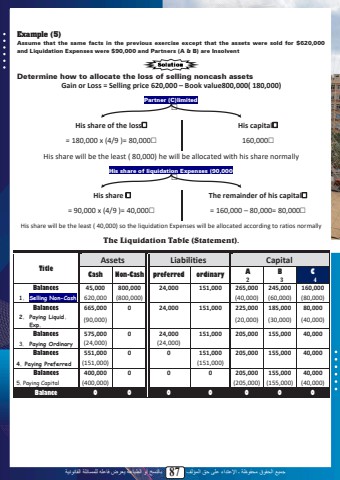
%u062c%u0645%u064a%u0639 %u0627%u0644%u062d%u0642%u0648%u0642 %u0645%u062d%u0641%u0648%u0638%u0629 %u0640 %u0627%u0625%u0644%u0639%u062a%u062f%u0627%u0621 %u0639%u0644%u0649 %u062d%u0642 %u0627%u0644%u0645%u0624%u0644%u0641 87 %u0628%u0627%u0644%u0646%u0633%u062e %u0623%u0648 %u0627%u0644%u0637%u0628%u0627%u0639%u0629 %u064a%u0639%u0631%u0636 %u0641%u0627%u0639%u0644%u0647 %u0644%u0644%u0645%u0633%u0627%u0626%u0644%u0629 %u0627%u0644%u0642%u0627%u0646%u0648%u0646%u064a%u0629Example (5)Assume that the same facts in the previous exercise except that the assets were sold for $620,000 and Liquidation Expenses were $90,000 and Partners (A & B) are InsolventDetermine how to allocate the loss of selling noncash assets Gain or Loss = Selling price 620,000 %u2013 Book value800,000( 180,000)Partner (C)limited%u02c7His share of the loss%u02c7 His capital%u02c7= 180,000 x (4/9 )= 80,000%u02c7 160,000%u02c7His share will be the least ( 80,000) he will be allocated with his share normallyHis share of liquidation Expenses (90,000%u02c7His share %u02c7 The remainder of his capital%u02c7= 90,000 x (4/9 )= 40,000%u02c7 = 160,000 %u2013 80,000= 80,000%u02c7His share will be the least ( 40,000) so the liquidation Expenses will be allocated according to ratios normally The Liquidation Table (Statement).TitleAssets Liabilities CapitalCash Non-Cash preferred ordinary A 2B 3C 4Balances 45,000 800,000 24,000 151,000 265,000 245,000 160,0001. Selling Non-Cash 620,000 (800,000) (40,000) (60,000) (80,000)Balances 665,000 0 24,000 151,000 225,000 185,000 80,0002. Paying Liquid. Exp. (90,000) (20,000) (30,000) (40,000)Balances 575,000 0 24,000 151,000 205,000 155,000 40,0003. Paying Ordinary (24,000) (24,000)Balances 551,000 0 0 151,000 205,000 155,000 40,0004. Paying Preferred (151,000) (151,000)Balances 400,000 0 0 0 205,000 155,000 40,0005. Paying Capital (400,000) (205,000) (155,000) (40,000)Balance 0 0 0 0 0 0 085


