


Page 28 - Demo
P. 28
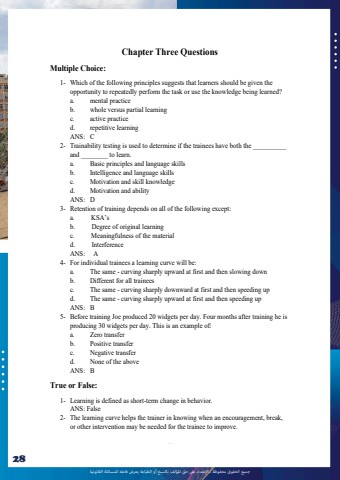
%u062c%u0645%u064a%u0639 %u0627%u0644%u062d%u0642%u0648%u0642 %u0645%u062d%u0641%u0648%u0638%u0629 %u0640 %u0627%u0625%u0644%u0639%u062a%u062f%u0627%u0621 %u0639%u0649%u0644 %u062d%u0642 %u0627%u0645%u0644%u0624%u0644%u0641 %u0628%u0627%u0644%u0646%u0633%u062e %u0623%u0648 %u0627%u0644%u0637%u0628%u0627%u0639%u0629 %u064a%u0639%u0631%u0636 %u0641%u0627%u0639%u0644%u0647 %u0644%u0644%u0645%u0633%u0627%u0626%u0644%u0629 %u0627%u0644%u0642%u0627%u0646%u0648%u0646%u064a%u062928Electronic Resources %u2013 Human Resources Development Year Four - 2021 | |28Chapter Three QuestionsMultiple Choice:1- Which of the following principles suggests that learners should be given the opportunity to repeatedly perform the task or use the knowledge being learned?a. mental practiceb. whole versus partial learningc. active practiced. repetitive learningANS: C2- Trainability testing is used to determine if the trainees have both the __________ and ________ to learn.a. Basic principles and language skillsb. Intelligence and language skillsc. Motivation and skill knowledged. Motivation and abilityANS: D3- Retention of training depends on all of the following except:a. KSA%u2019sb. Degree of original learningc. Meaningfulness of the materiald. InterferenceANS: A4- For individual trainees a learning curve will be:a. The same - curving sharply upward at first and then slowing downb. Different for all traineesc. The same - curving sharply downward at first and then speeding upd. The same - curving sharply upward at first and then speeding upANS: B5- Before training Joe produced 20 widgets per day. Four months after training he is producing 30 widgets per day. This is an example of:a. Zero transferb. Positive transferc. Negative transferd. None of the aboveANS: BTrue or False:1- Learning is defined as short-term change in behavior.ANS: False2- The learning curve helps the trainer in knowing when an encouragement, break, or other intervention may be needed for the trainee to improve.


